


When engineering complex real-time systems, the Unified Modeling Language (UML) serves as the blueprint for logic and behavior. However, even minor inconsistencies in state machines can lead to critical runtime failures. This guide provides a structured approach to diagnosing and resolving state transition errors without relying on specific commercial tools or marketing fluff. We focus on the underlying logic, verification methods, and architectural patterns that ensure system integrity.
🧩 Understanding State Machine Architecture
State machines are fundamental to modeling reactive systems. They define how a system reacts to events based on its current condition. In real-time contexts, timing and concurrency add layers of complexity that often trigger modeling errors.
- States: Represent distinct modes of operation (e.g., Idle, Processing, Error).
- Transitions: Directed edges connecting states, triggered by events.
- Events: Signals that initiate state changes.
- Actions: Operations performed upon entering, exiting, or during a transition.
Inconsistent transitions occur when the model allows a path that the implementation cannot execute, or when the model describes a behavior that violates system constraints. This creates a divergence between the design and the deployed software.
⚠️ Common Causes of Inconsistent Transitions
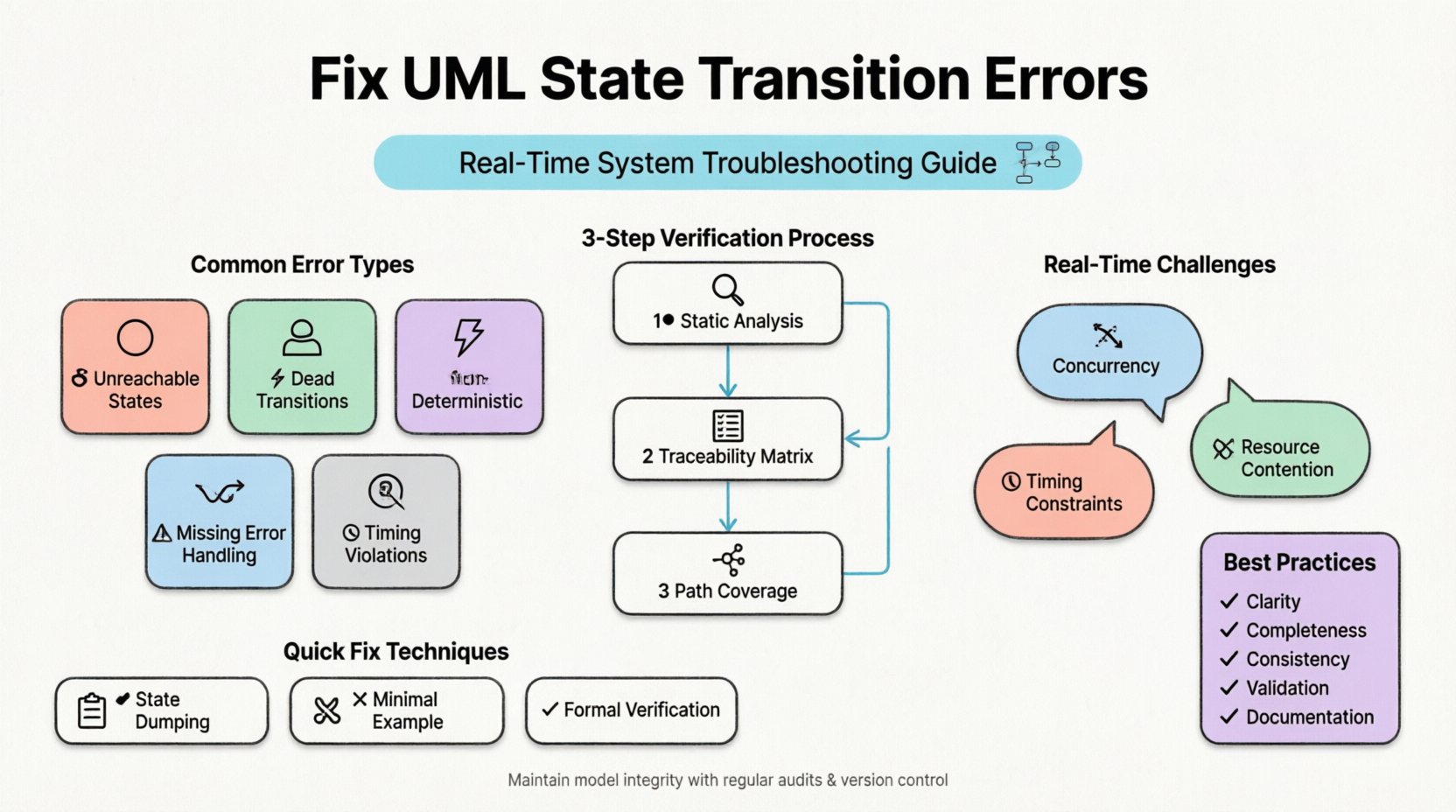
Identifying the root cause requires a systematic breakdown of the model. Below is a table detailing frequent error patterns and their technical implications.
| Error Type | Description | Impact on Real-Time Systems |
|---|---|---|
| Unreachable States | States that cannot be entered from the initial state | Dead code, wasted resources, potential deadlock |
| Dead Transitions | Transitions with no valid trigger or guard condition | System hangs, failure to respond to critical events |
| Non-Deterministic Paths | Multiple transitions triggered by the same event from the same state | Unpredictable behavior, race conditions |
| Missing Error Handling | No transition defined for exceptional events | System crash or undefined state on failure |
| Timing Violations | Transitions dependent on time that exceed real-time constraints | Missed deadlines, safety violations |
🔍 Step-by-Step Verification Process
To resolve these issues, follow a rigorous verification workflow. This process moves from static analysis to dynamic simulation logic.
1. Static Structural Analysis
Before running simulations, inspect the diagram for structural anomalies. This step catches logical errors without executing code.
- Check Initial and Final States: Ensure every path eventually reaches a defined end point or loops back to a stable state.
- Validate Event Coverage: For every state, verify that all expected external events have a corresponding transition.
- Review Guard Conditions: Ensure boolean expressions are syntactically valid and do not contain contradictions (e.g.,
speed > 100 AND speed < 50). - Analyze Hierarchy: If using nested states, verify that entry/exit points propagate correctly to parent states.
2. Traceability Matrix Creation
Linking model elements to requirements prevents scope creep and logic gaps. Create a matrix that maps each state and transition to a specific functional requirement.
- Map State A to Requirement 1.0.1
- Map Transition Event X to Requirement 1.0.2
- Highlight any requirements without corresponding model elements
- Highlight any model elements without corresponding requirements
This bidirectional mapping ensures that the model reflects the actual system needs and that all modeled behaviors are justified.
3. Path Coverage Analysis
In complex state machines, manual tracing is insufficient. You must verify that all possible execution paths are accounted for.
- Simple Paths: Trace the most direct route from start to finish.
- Loop Paths: Verify that loops terminate or have a defined exit condition.
- Error Paths: Trace how the system recovers from failures.
- Parallel Paths: If using composite states, verify that internal states do not conflict.
⚡ Handling Concurrency and Real-Time Constraints
Real-time systems often operate concurrently. A single state machine may not be enough to describe the whole system. This is where inconsistencies frequently arise.
1. Inter-State Communication
When multiple state machines interact, events must be synchronized. Inconsistencies occur when one machine expects an event that another machine does not send.
- Define clear interfaces between state machines.
- Ensure event naming is consistent across all diagrams.
- Document the priority of simultaneous events.
- Verify that event queues do not overflow under high load.
2. Timing Constraints
Real-time requirements dictate that certain actions must occur within a specific timeframe. Modeling this in UML requires careful use of timers and guards.
- Timers: Use timer events to trigger transitions after a duration.
- Guards: Use guard conditions to check if a time limit has been reached.
- Timeouts: Define explicit timeout states to handle missed deadlines.
- Synchronization: Ensure that time-based transitions do not conflict with event-based transitions.
3. Resource Contention
States often consume resources. If two transitions require the same resource simultaneously, a deadlock may occur in the model.
- Identify all shared resources in the state machine.
- Model resource locking mechanisms explicitly.
- Check for circular dependencies in state transitions.
- Ensure resource release occurs in exit actions to prevent leaks.
🛠 Practical Troubleshooting Techniques
When inconsistencies are detected, use these techniques to isolate and fix the problem.
Technique A: State Dumping
During simulation or testing, log the current state of the system at every step. This helps identify the exact point where the model diverges from expected behavior.
- Log entry into every state.
- Log the trigger event for every transition.
- Log the value of variables involved in guard conditions.
- Compare logs against the model specification.
Technique B: Minimal Example Creation
Complex models are hard to debug. Create a simplified version of the state machine that isolates the problematic behavior.
- Remove non-essential states.
- Simplify guard conditions to true.
- Focus on the specific transition causing the error.
- Once fixed, reintegrate complexity gradually.
Technique C: Formal Verification
For safety-critical systems, use formal methods to prove the correctness of the state machine. This involves mathematically proving that certain bad states are unreachable.
- Define invariants for the system state.
- Verify that transitions preserve these invariants.
- Use model checking tools to explore all possible states.
- Document the proof for compliance audits.
📝 Documentation and Maintenance
Fixing errors is only half the battle. Maintaining the integrity of the model over time is equally important.
1. Version Control for Models
Just like source code, model files should be version controlled. This allows you to track changes and revert if a new modification introduces inconsistencies.
- Commit changes after every logical update.
- Write descriptive commit messages explaining the change.
- Tag releases when the model is stable.
- Review diffs before merging changes.
2. Change Impact Analysis
Before modifying a state machine, analyze the impact on other parts of the system.
- Identify all transitions dependent on the changed state.
- Check if parent or child states are affected.
- Verify that interface contracts remain valid.
- Update related documentation to reflect the change.
3. Regular Audits
Schedule periodic reviews of the state diagrams. Over time, technical debt can accumulate in the form of legacy states or obsolete transitions.
- Review the model quarterly or with each major release.
- Remove unused states and transitions.
- Validate guard conditions against current business logic.
- Ensure documentation matches the current model version.
🔄 Handling Nested and Composite States
Nested states allow for hierarchical modeling, which is essential for complex systems. However, they introduce scope issues that can lead to inconsistent transitions.
1. Context Awareness
Events in nested states may behave differently depending on the parent context. Ensure that event propagation rules are clearly defined.
- Define whether events bubble up to parent states.
- Clarify if parent state events are visible to child states.
- Document the scope of local vs. global events.
- Verify that exit actions of child states do not interfere with parent transitions.
2. History States
History states allow the system to return to the last active substate. Misuse of history states can lead to unpredictable behavior.
- Distinguish between deep history (specific substate) and shallow history (any substate).
- Ensure history states are only used when the previous context is meaningful.
- Test transitions that involve history states thoroughly.
- Document the expected behavior of history states in the design spec.
🧪 Testing the Model
Even a perfect model requires validation through testing. This step confirms that the logic holds up under various conditions.
- Unit Testing: Test individual states and transitions in isolation.
- Integration Testing: Verify interactions between multiple state machines.
- Stress Testing: Push the system to its limits to find race conditions.
- Regression Testing: Ensure fixes do not break existing functionality.
🎯 Summary of Best Practices
To maintain a robust UML state model, adhere to these core principles:
- Clarity: Use clear naming conventions for states and events.
- Completeness: Ensure every state has defined entry and exit behavior.
- Consistency: Keep the model synchronized with the implementation.
- Validation: Use formal methods and simulation to verify logic.
- Documentation: Keep design specs up to date with model changes.
🔮 Looking Forward
As systems become more distributed and autonomous, the demand for precise modeling will increase. State machines will continue to be a cornerstone of system design, but the tools and methods for verification must evolve alongside the complexity of the software. By following a disciplined approach to troubleshooting and maintenance, teams can ensure that their models remain reliable assets throughout the lifecycle of the product.
Consistency in state transitions is not just a technical requirement; it is a guarantee of system safety and reliability. Take the time to verify every path, and the resulting software will reflect that attention to detail.