


Unified Modeling Language (UML) serves as the blueprint for software architecture. Among its most critical relationships is generalization. It defines how specific classes relate to broader categories. Despite its fundamental nature, generalization often causes misunderstanding. Many practitioners confuse it with simple association or struggle with the nuances of polymorphism. This guide provides a detailed examination of these concepts.
We will explore the mechanics of inheritance within class diagrams. We will distinguish between structural inheritance and behavioral polymorphism. By addressing frequent questions, we aim to remove ambiguity from your design process. Precision in modeling leads to precision in code.
🧩 Understanding Generalization in UML
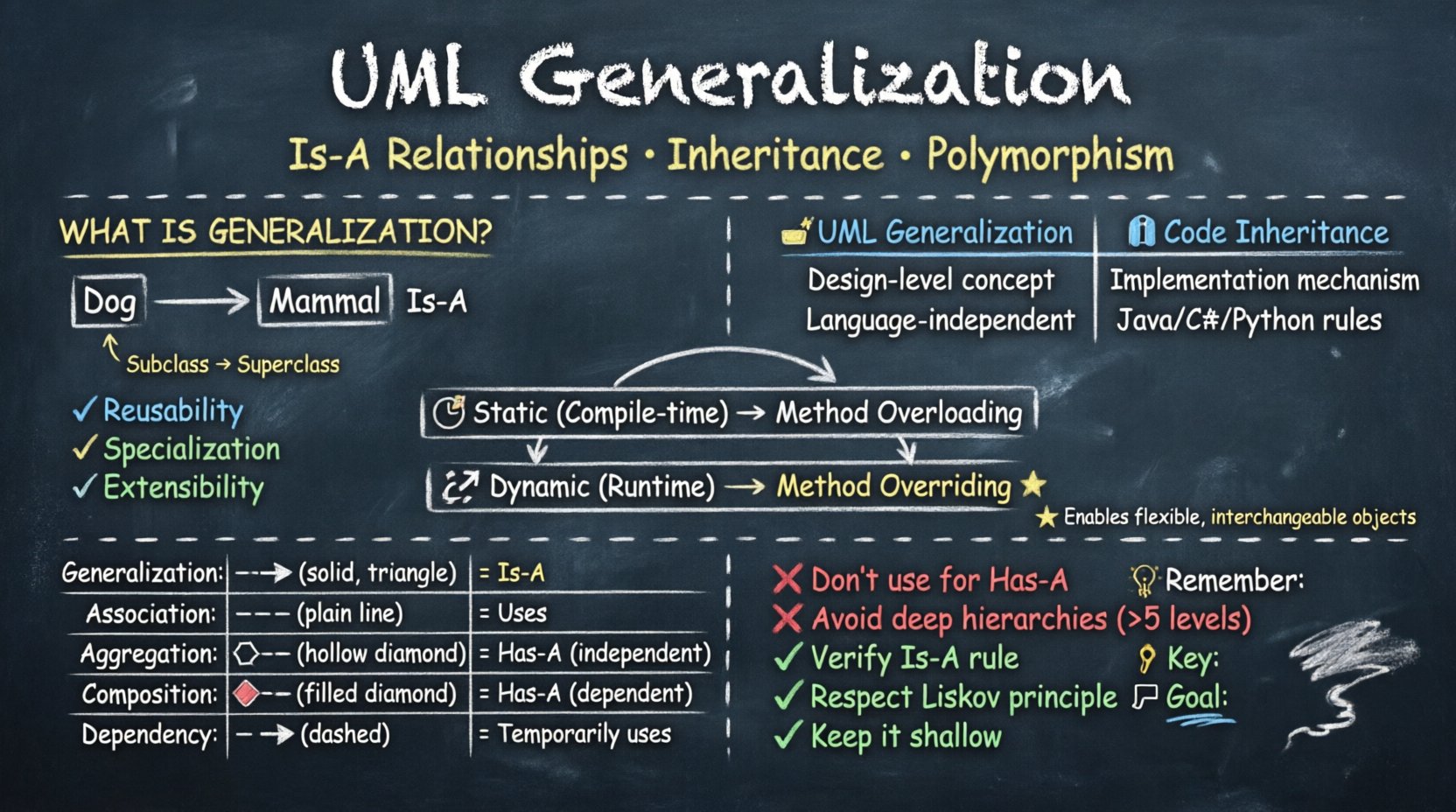
Generalization represents a taxonomic relationship. It signifies that a specific element is a specialized version of a more general element. In object-oriented programming, this translates directly to inheritance. However, UML generalization exists at the design level, independent of implementation language.
- Direction: The arrow points from the specific (subclass) to the general (superclass).
- Visual: A solid line with a closed, unfilled triangle arrowhead.
- Semantics: “Is a” relationship. A Dog is a Mammal.
This relationship implies that the subclass inherits the attributes and operations defined in the superclass. It allows for the reuse of common logic while enabling specific behaviors.
🔍 Key Characteristics
- Reusability: Common code resides in the parent class.
- Specialization: Child classes add unique features or override existing ones.
- Extensibility: New types can be added without altering the parent.
🔗 The Relationship Between Inheritance and Generalization
While often used interchangeably, subtle distinctions exist between the modeling term and the coding term.
📌 UML Generalization
Generalization is the modeling abstraction. It describes the conceptual hierarchy. It does not necessarily dictate how memory is laid out or how methods are dispatched in a specific runtime environment. It defines the contract of the hierarchy.
📌 Object-Oriented Inheritance
Inheritance is the implementation mechanism. It is how the code realizes the generalization. Languages like Java or C# enforce strict inheritance rules. UML allows for more flexibility, such as multiple inheritance in specific contexts, provided the implementation supports it.
Consider the following points regarding their alignment:
- One-to-One Mapping: Most generalizations map directly to class inheritance.
- Interface Implementation: UML treats interface realization as a form of generalization, though some tools draw it with a dashed line.
- Abstract Classes: Generalization often involves abstract elements that cannot be instantiated.
🔄 Polymorphism: Behavior vs Structure
Polymorphism is the ability of different objects to respond to the same message in different ways. It relies on generalization to function. Without a hierarchy, polymorphism is limited.
🧠 Static vs Dynamic Polymorphism
Understanding the type of polymorphism is vital for accurate modeling.
- Compile-time (Static): Method overloading. Different methods with the same name but different parameters.
- Runtime (Dynamic): Method overriding. A child class provides a specific implementation of a parent method.
In UML, polymorphism is visualized through the operations defined in the superclass. When you see a generalization line, you are implicitly defining a polymorphic contract.
❓ Common Questions and Answers
Designers frequently encounter specific scenarios where the rules of generalization are tested. Below are detailed answers to common inquiries.
1. Can I use Generalization for Aggregation?
No. Aggregation is a “has-a” relationship, not an “is-a” relationship. If a Car has an Engine, you should use an association line, not a generalization arrow. Confusing these two leads to flawed inheritance hierarchies.
- Aggregation: A container relationship. The parts can exist independently.
- Generalization: An identity relationship. The child cannot exist without the definition of the parent.
2. How do I represent Interface Implementation?
UML provides a specific notation for this. While generalization implies inheritance of state and behavior, interface implementation often implies only behavior.
- Generalization: Solid line, closed triangle.
- Interface Realization: Dashed line, closed triangle.
However, semantically, implementation is a form of generalization. The implementing class is a type of the interface.
3. Is Multiple Inheritance Allowed?
UML supports multiple generalization. A class can inherit from more than one parent. This creates a diamond shape in the diagram.
- Pros: High code reuse from multiple sources.
- Cons: Ambiguity in method resolution (the Diamond Problem).
While UML permits this, many modern languages restrict it. You must ensure your target platform supports multiple inheritance if you model it this way.
4. What is the difference between Abstract and Concrete?
Abstract classes define the blueprint. They cannot be instantiated. Concrete classes implement the details. In a generalization hierarchy, the top levels are often abstract, while the bottom levels are concrete.
📊 Relationship Comparison Table
To ensure clarity, comparing generalization against other common relationships is helpful.
| Relationship Type | Visual Notation | Semantic Meaning | Example |
|---|---|---|---|
| Generalization | Solid line, closed arrow | Is-a | Vehicle → Car |
| Association | Solid line | Uses / Connected to | Driver → Car |
| Aggregation | Hollow diamond | Has-a (independent) | Department → Professor |
| Composition | Filled diamond | Has-a (dependent) | House → Room |
| Dependency | Dashed line, open arrow | Uses temporarily | Report → Database |
⚠️ Design Pitfalls to Avoid
Even experienced architects make mistakes when applying generalization. These errors often stem from forcing a hierarchy where none exists.
🛑 The Fragile Base Class Problem
Changing a method in a superclass can break subclasses. This is a risk when the hierarchy is deep. Limit the depth of your generalization trees.
🛑 Violating the Liskov Substitution Principle
Subclasses must be substitutable for their base classes without altering the correctness of the program. If a subclass changes the contract of a parent method, the generalization is invalid.
- Wrong: A Square class inherits from Rectangle but changes how width affects height.
- Right: Use composition to relate Square and Rectangle if they behave differently.
🛑 Deep Inheritance Hierarchies
A hierarchy with five or more levels is difficult to maintain. It creates tight coupling. Consider flattening the hierarchy or using composition instead.
🛠 Implementation Considerations
Translating UML generalization to code requires attention to language specifics.
🔹 Access Modifiers
UML does not strictly enforce visibility, but code does. Ensure that protected members in the superclass are correctly mapped. Private members are not inherited.
🔹 Constructors
Initialization logic in the parent class must be compatible with the child. UML constructors are often omitted for brevity, but they are critical for object lifecycle management.
🔹 Virtual Methods
For polymorphism to work, methods must be marked as virtual or abstract. Without this, the child class cannot override the parent, and the generalization loses its dynamic power.
🧪 Real-World Scenarios
Let us examine how this applies in practical contexts.
📦 E-Commerce Product Hierarchy
Consider a system managing products. You might model a base class called Product.
- Product: ID, Name, Price.
- Book: Author, ISBN.
- Electronics: Warranty, Voltage.
Here, Generalization allows a list of Product to hold Book and Electronics objects. A loop iterating over Product can print the price for any item.
🔐 Authentication System
Authentication often uses generalization for user types.
- User: Login, Password.
- Admin: Manage Users, View Logs.
- Guest: No Login.
Generalization ensures that the Admin and Guest share the core identity logic of a User, while adding specific permissions.
🎨 Visualizing Complex Hierarchies
When diagrams become crowded, clarity suffers. Use the following strategies to maintain readability.
- Grouping: Use packages to contain related hierarchies.
- Abstraction: Show the top-level generalization in the main diagram. Link to detailed diagrams for lower levels.
- Notes: Use UML notes to explain complex inheritance logic that cannot be drawn with lines.
🔑 Summary of Best Practices
To maintain a robust system design, adhere to these guidelines regarding generalization.
- Verify the “Is-A” Rule: If it does not pass this test, do not use generalization.
- Keep it Shallow: Avoid deep nesting of classes.
- Respect the Contract: Do not weaken the postconditions of parent methods.
- Document Intent: Use comments to explain why a specific inheritance exists.
- Test Polymorphism: Ensure that overriding methods behave as expected in all contexts.
By following these standards, you create models that are not only accurate representations of the system but also guide the development team effectively. The clarity of the diagram reduces the likelihood of implementation errors.
🚀 Moving Forward
UML generalization is a powerful tool when used correctly. It provides structure and consistency to complex systems. Understanding the distinction between the model and the code is essential. Focus on the semantic meaning of the relationships rather than just the syntax.
Regularly review your class diagrams. As requirements change, the hierarchy may need adjustment. Flexibility in design is key. Always prioritize maintainability over immediate convenience.