


The landscape of software engineering is shifting. For decades, Unified Modeling Language (UML) has served as the standard blueprint for system architecture. Historically, these diagrams were created during the design phase and often stored in repositories, disconnected from the actual code. However, a significant transformation is underway. The future of software development lies in the tight integration of visual models with automated code review workflows. This convergence promises to reduce technical debt, improve consistency, and bridge the gap between abstract design and concrete implementation. 🛠️
This guide explores the technical realities and strategic implications of embedding UML diagrams into modern automated pipelines. We will examine the evolution of model-driven approaches, the mechanics of integration, and the challenges that must be overcome to achieve true alignment between design and code.
Understanding the Current State of UML 📜
UML was not designed to be a programming language, yet its syntax is structured enough to define system behavior precisely. In traditional workflows, a developer creates a class diagram or sequence diagram, and another developer implements the code based on it. This separation often leads to “code drift,” where the implementation diverges from the original design intent over time. This drift creates documentation debt that is expensive to manage.
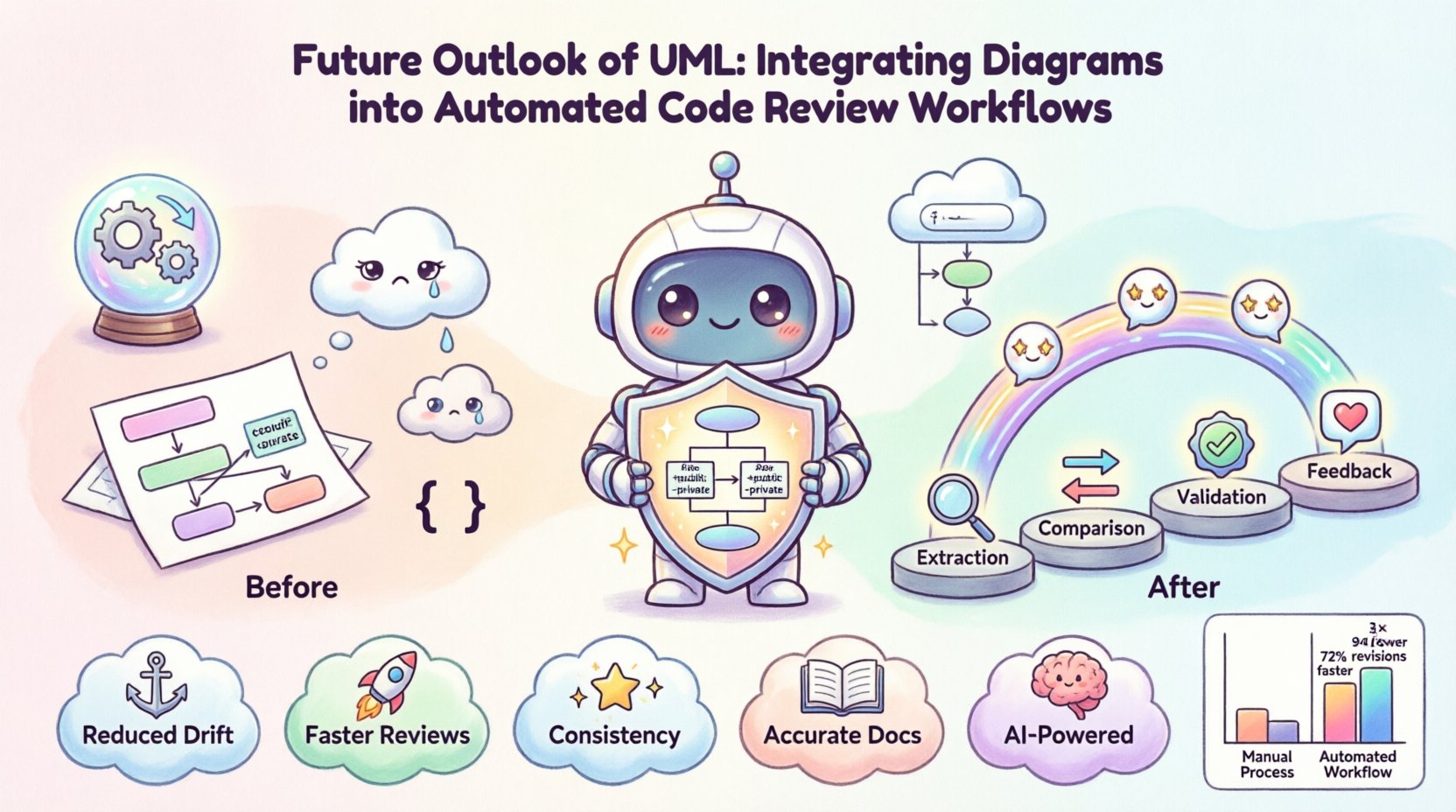
To address this, the industry is moving towards bidirectional synchronization. This means the code should be able to generate the diagram, and the diagram should be able to validate the code. This concept is central to Model-Driven Architecture (MDA). By treating diagrams as living artifacts rather than static documentation, teams can enforce architectural rules automatically.
Key Characteristics of Modern UML Implementation
- Executable Models: Diagrams are no longer just visual aids. They define behavior that can be validated before compilation.
- Traceability: Every line of code is traceable back to a specific element in the model.
- Version Control: Diagram files are treated with the same rigor as source code, stored in version control systems alongside the application logic.
- Automation: Processes that extract metrics from diagrams and compare them against codebases are becoming standard.
The Mechanics of Automated Code Review Integration 🔍
Integrating diagrams into automated workflows requires a shift in how pipelines are constructed. Typically, a code review workflow involves static analysis, linting, and unit testing. Adding UML requires a new stage where the model is parsed, validated, and compared against the generated code.
This integration happens at several layers of the software development lifecycle (SDLC). The most effective approach embeds model validation directly into the Continuous Integration (CI) pipeline. When a developer pushes code, the system extracts the current state of the model and checks for discrepancies.
Workflow Stages for Integration
- Extraction: The build process extracts structural information from the source code (classes, methods, relationships).
- Comparison: This extracted data is compared against the canonical UML model stored in the repository.
- Validation: Rules are applied to ensure the code adheres to architectural constraints defined in the diagram.
- Feedback: If discrepancies exist, the pipeline fails, and the developer receives specific feedback on the deviation.
This loop ensures that the visual representation of the system remains accurate. It prevents developers from introducing patterns that violate the intended architecture without realizing it. The goal is not to replace code review, but to augment it with architectural context.
Technical Challenges in Model-Code Synchronization ⚙️
While the concept is sound, the implementation presents significant technical hurdles. The complexity arises from the fundamental differences between the abstraction levels of code and diagrams.
1. Semantic Drift and Ambiguity
UML allows for a degree of abstraction that code does not. A sequence diagram might show a method call without specifying the exception handling logic. When code is generated or reviewed, these missing details must be accounted for. If the model is too abstract, it offers little value for automated review. If it is too detailed, it becomes brittle and hard to maintain. Finding the balance is critical.
2. Tooling Fragmentation
There is no universal standard for how diagram files are stored or interpreted. Different tools use different file formats for the same models. An automated workflow must be able to parse these formats without relying on specific proprietary software. This requires the use of open standards and generic parsers.
3. Performance Overhead
Generating models from large codebases can be computationally expensive. If the automated review process takes too long, it slows down the feedback loop for developers. Teams must optimize the extraction logic to run only on changed files rather than the entire repository.
Bridging the Gap: Strategies for Success 🤝
Successful integration requires a disciplined approach to modeling. It is not enough to simply generate diagrams from code. The process must be designed to maintain fidelity.
1. Define Clear Architectural Rules
Before automating the review, teams must define what constitutes a valid architecture. This includes rules about layering, dependency injection, and interface usage. These rules are then encoded into the model validation logic.
2. Incremental Adoption
Attempting to model an entire legacy system at once is rarely successful. Teams should start with critical modules or new features. This allows the workflow to stabilize before expanding to the whole codebase.
3. Feedback Loops
Developers need to see the results of the model check. The output should be human-readable, highlighting exactly which diagram element conflicts with which code block. Vague errors lead to frustration and eventual abandonment of the process.
Future Trends: AI and Diagrammatic Intelligence 🤖
The next frontier for UML integration involves Artificial Intelligence. Large Language Models (LLMs) are increasingly capable of interpreting visual data and generating code. This capability opens new possibilities for automated code review.
1. AI-Assisted Model Correction
When a code review fails due to a model mismatch, AI can suggest fixes. It can analyze the code and propose a modification to the diagram that aligns with the implementation, or vice versa.
2. Natural Language to Diagrams
Requirements written in natural language can be converted into UML diagrams automatically. This reduces the initial overhead of creating models and ensures that the diagrams reflect the actual business requirements.
3. Predictive Analysis
By analyzing the relationship between diagram patterns and code quality metrics, systems can predict where bugs are likely to occur. If a specific class structure appears in a diagram, the code review tool can flag that section for deeper scrutiny.
Comparison: Manual vs. Automated Review Metrics 📊
To understand the value of this integration, it is helpful to compare key metrics between traditional manual reviews and automated UML-integrated reviews.
| Metric | Manual Review Only | Automated UML Integration |
|---|---|---|
| Drift Detection | Low (Human oversight) | High (Automated comparison) |
| Review Speed | Slow (Dependent on reviewer) | Fast (Pipeline execution) |
| Consistency | Variable (Human error) | High (Rule-based enforcement) |
| Documentation Accuracy | Low (Often outdated) | High (Synchronized with code) |
| Developer Friction | Medium (Context switching) | Low (Inline feedback) |
Best Practices for Implementation 📋
Implementing this workflow requires careful planning. Here are actionable steps to ensure success.
- Standardize File Formats: Ensure all diagrams use an open format that can be parsed by generic tools.
- Keep Models Lean: Do not model everything. Focus on structural relationships and critical data flows.
- Integrate with CI/CD: Make model validation a mandatory gate in the deployment pipeline.
- Train the Team: Developers must understand how to read and update the diagrams. If they view them as overhead, the process will fail.
- Monitor Metrics: Track the number of violations and the time spent on model maintenance to gauge ROI.
The Role of Static Analysis in Model Validation ⚖️
Static analysis tools are the engine that powers automated code review. When integrated with UML, these tools go beyond syntax checking. They check architectural compliance.
For example, a static analysis tool can verify that no class in the “Presentation Layer” directly accesses the “Database Layer”. In a UML-integrated workflow, this rule is defined in the diagram as a dependency constraint. The code review tool enforces this constraint automatically.
Common Violations Caught by Integration
- Violation of Layering: Code exists in the wrong architectural layer.
- Missing Interfaces: A method exists in the code but is not defined in the interface diagram.
- Orphaned Classes: Classes in the code have no representation in the design model.
- Broken Relationships: Inheritance or association links defined in the diagram do not exist in the code.
Conclusion on the Trajectory of UML 🚀
The future of UML is not in static documentation, but in active participation within the development lifecycle. By integrating diagrams into automated code review workflows, teams can ensure that their architecture remains intact as the codebase grows. This approach reduces the risk of refactoring, improves code quality, and maintains a single source of truth.
While challenges remain regarding tooling and standardization, the trend is clear. The separation between design and code is closing. The diagrams are becoming executable specifications, and the code is becoming the living proof of the model. This synchronization is essential for maintaining complex software systems in an era of rapid delivery.
Organizations that adopt this mindset will find themselves better equipped to handle technical debt. They will have the visibility to see architectural deviations before they become critical failures. The integration of UML into automated workflows is not just a technical upgrade; it is a strategic advantage for long-term software sustainability.
As tools evolve and standards mature, the friction of this integration will decrease. The result will be a development environment where design and implementation are indistinguishable. Until then, the focus must be on disciplined modeling and robust automation. The path forward requires commitment, but the destination is a more reliable and maintainable software ecosystem.
Related posts:
 Visual UML: A Step-by-Step Walkthrough for Junior Developers to Design Scalable Systems
 Future Outlook of UML: Will Traditional Diagrams Survive the Rise of AI-Generated Code?
 Checklist for Validating UML Models: Ensuring Consistency Before Code Generation Begins
 Definitive Overview of UML Interaction Overview Diagrams: Handling Nonlinear Control Flow